
Why does this matter?
One thing I’ve noticed over and over in my work in tourism is that many travelers hit the same snag: Iran’s calendar isn’t the same as the one most countries use. Most places run on the Gregorian calendar, while Iran uses the Solar Hijri calendar (also called the Jalali calendar and commonly searched as the Iranian calendar).
If you’re the kind of person who plans trips precisely and in detail, I recommend reading this to the end. Don’t worry!!! This isn’t one of those time-sucking guides. I’m just trying to help you squeeze the most out of your trip.
Days of the Week (quick win)
The days of the week in Iran are the same as everywhere else. If it’s Saturday somewhere else, it’s Saturday in Iran too. That’s that. (If you ever need to double-check iran calendar today, just remember the week alignment is the same; only the date format is different.)
The Weekend in Iran Is Different
One of the most important things to know is that Iran’s weekend is different. Your weekend is probably Saturday–Sunday, while in Iran it’s Thursday and Friday. That means when you’re planning your trip, you should definitely check in advance whether the places you want to visit are open on Fridays or not! Some museums or specific places may be closed on Fridays, like the Tehran Grand Bazaar.
Tehran Grand Bazaar is one of those spots most travelers love to visit just to feel the space and atmosphere, but it’s closed on Fridays, and on Thursdays, it’s open only until the afternoon.
So, if you need anything from an embassy, consulate, or any administrative office, they usually work Thursdays until around noon and are closed on Fridays. Keep that in mind, too.
Iran calendar today date and time
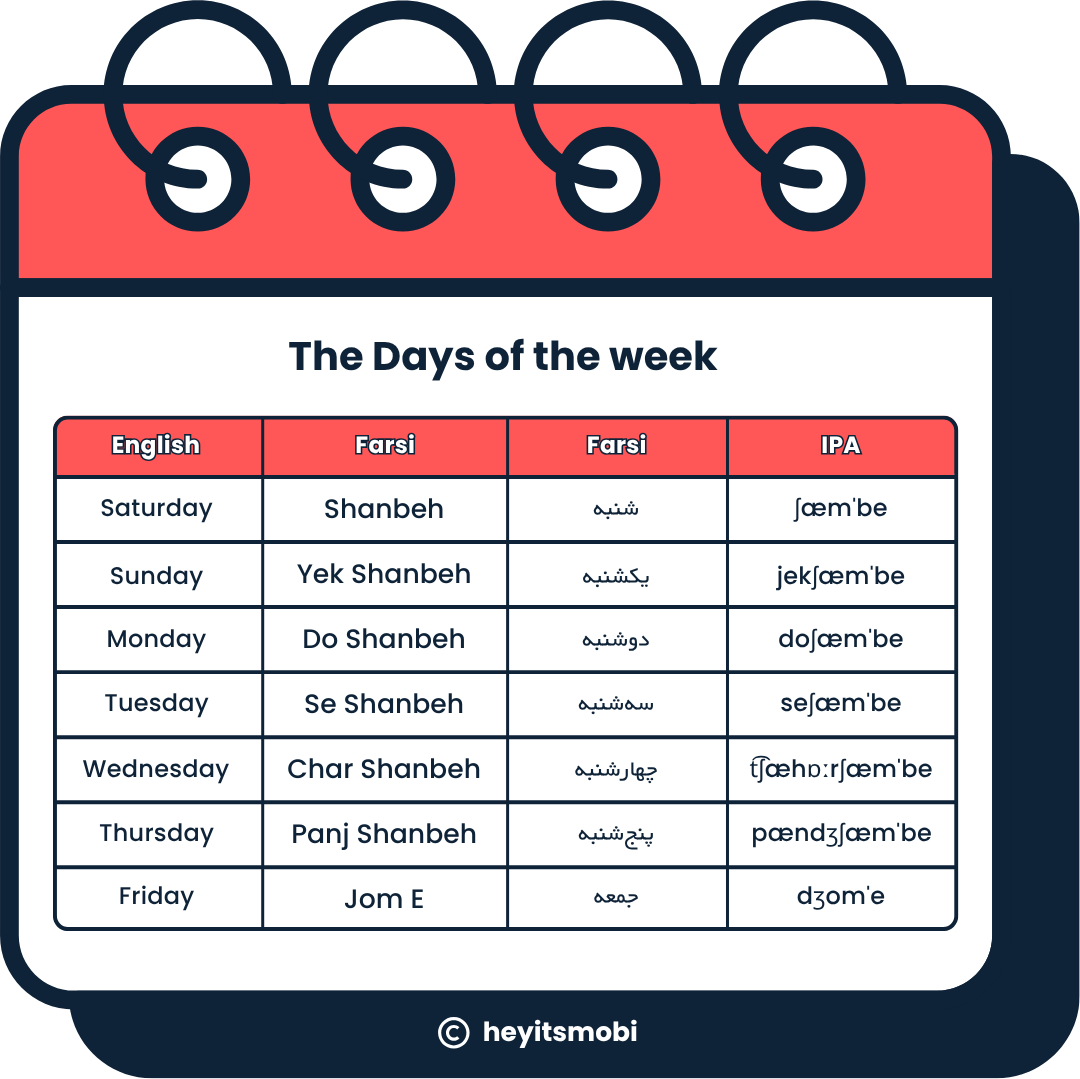
The Months of the Year (what lines up with what)
Naturally, since Iran’s calendar system is different from other countries, the months are different too. The day-number offset between the two calendars slides by about 9 to 11 days, and it changes each month. For example, I’m writing this on October 27, which is Aban 5 in Iran. In some months, you might see something like the 15th of the Gregorian month lining up with the 5th of the Solar Hijri month. It’s not a big deal, but I’m mentioning it so you have the full picture.
Another thing: in the Solar Hijri or Iranian calendar, the first 6 months have 31 days, the next 5 months have 30 days, and the last month has 29 days. Every leap year, that last month becomes 30 days—we call that a leap year! (Technically, leap years are tied to the exact time between two spring equinoxes, which is why the Iranian calendar is so accurate.)
If you’re the type who loves tools, a quick Iranian calendar converter search will map dates for you instantly—handy when you’re booking tickets or museum days.
Quick month map (handy for planning):
Farvardin ≈ Mar 21–Apr 20
Ordibehesht ≈ Apr 21–May 21
Khordad ≈ May 22–Jun 21
Tir ≈ Jun 22–Jul 22
Mordad ≈ Jul 23–Aug 22
Shahrivar ≈ Aug 23–Sep 22
Mehr ≈ Sep 23–Oct 22
Aban ≈ Oct 23–Nov 21
Azar ≈ Nov 22–Dec 21
Dey ≈ Dec 22–Jan 20
Bahman ≈ Jan 21–Feb 19
Esfand ≈ Feb 20–Mar 20.
Fun fact: the Solar (Jalali) calendar is widely regarded as one of the most accurate calendars in the world—and yes, Omar Khayyam’s name shows up in its early history.
New Year in Iran (Nowruz & the spring equinox)
Each year in Iran starts with the spring equinox and the beginning of spring. As you probably know, the Iranian calendar is tied to the Sun, so when we pass the exact moment of the spring equinox, spring begins, and a new year starts; this is Nowruz. Because it’s linked to the sky (not a fixed date), that “Farvardin 1” moment generally lands around March 20/21.
Also, Iran is a four-season country. You might say, “Isn’t everywhere?”, but honestly, not everywhere is like this. We get all four seasons—spring, summer, autumn, winter—and at the same time, different parts of the country can feel like different seasons. For example, in winter, the northern parts can be cold and snowy, while it’s the best time to visit the southern parts because the weather there is milder. Depending on latitude, some places feel like spring, others feel like summer, you get the idea.
That said, the first part (going through all four seasons) used to feel more obvious. Climate change is messing with that rhythm. Right now we’re in the middle of autumn, and it should be rainy and crisp, but unfortunately, it’s still warm!!!
Just like anywhere else that celebrates the New Year, Iran has its own celebrations and traditions called Nowruz. I’ll definitely write about that too.
Official Holidays in Iran (what to expect)
Every country has several official public holidays when most places close. I once saw an Instagram post (can’t remember which page) saying the U.S. has 11 public holidays a year. Since Iran’s history merged with Islam at a certain point, and Iran is an Islamic country today, we have religious holidays in addition to national ones, and they’re all counted as official. These include, for example, the passing of the Prophet of Islam, the martyrdom of some Shia Imams, their birthdays, and other major Islamic dates. When you plan your trip, keep an eye on these as well.
Key Official Holidays You Should Know About (Arba’een & co.)
There are a few holidays you really should know about for trip planning—mostly because it might get hard to find plane, train, bus, or even intercity taxi tickets, or prices might jump!!!
Religious holiday dates may vary by moon-sighting; always recheck close to travel.
A big example is Arba’een. In Islamic and Iranian culture, forty days after someone passes away, there’s a memorial we call the “chehelom” (the fortieth). Arba’een is an Arabic word, and Arba’een Day is the fortieth day after the martyrdom of Imam Husayn, the third Shia Imam. It’s extremely sacred and important. Those who observe it often begin the Arba’een walk about three weeks beforehand—people travel by bus or train toward the Iraq border, then walk to Karbala for pilgrimage.
Around Arba’een, intercity buses are almost unavailable; if you do find one, it’s much more expensive than usual because buses are scarce. Taxi prices also go higher than normal, and… well, you get the picture. I just wanted to flag it so you factor it in.
On the flip side, the customs and culture around Arba’een differ from city to city and village to village across Iran. If you’re into local traditions, I highly recommend joining one of these ceremonies.
2026 Calendar
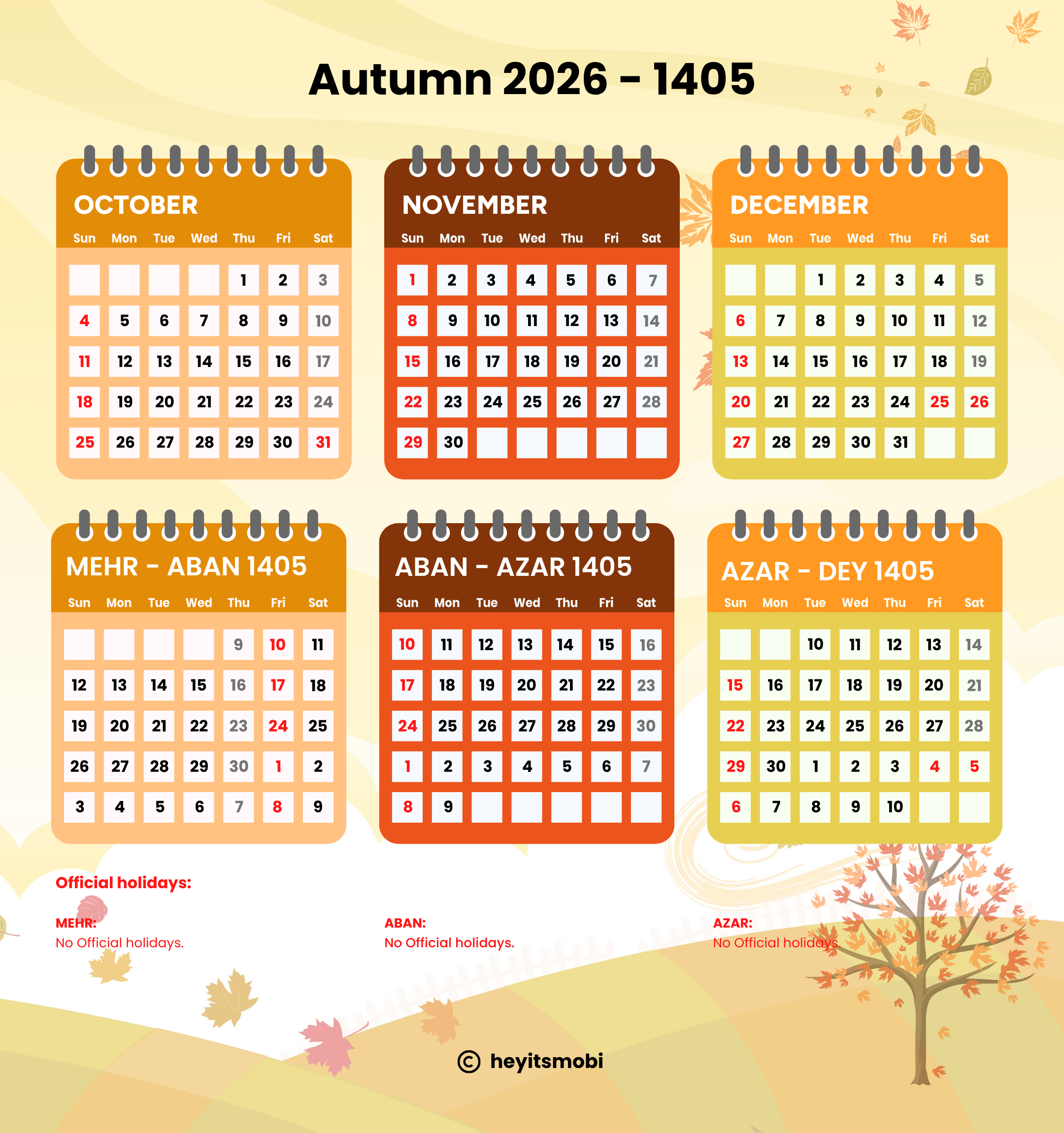
I’ve merged the 2026 Gregorian and 1404–1405 Solar Hijri calendars, and I’ll list the official holidays below. When writing your travel plan, give it a quick review.
Iran calendar today date and time
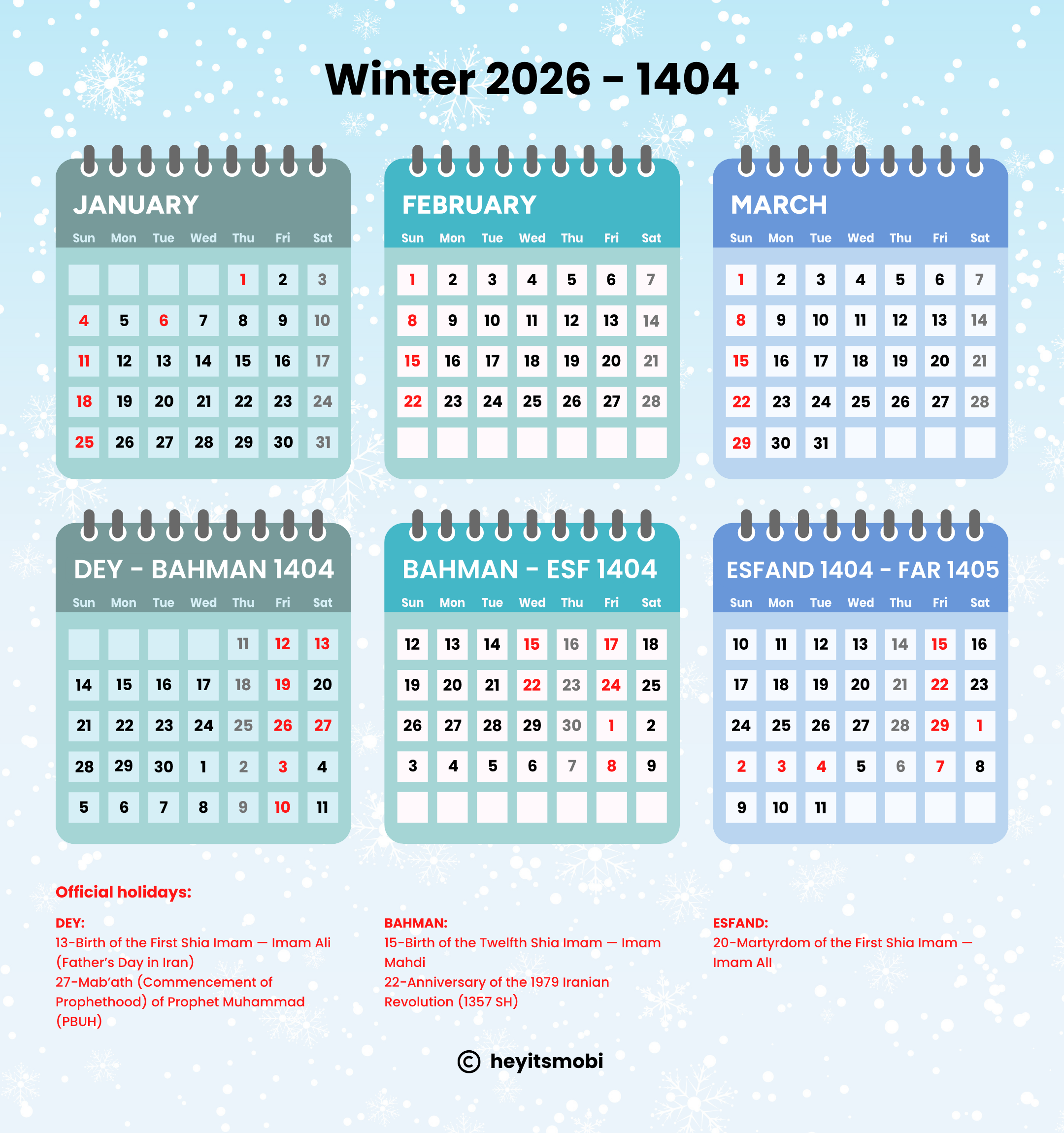 Winter 2026-1404
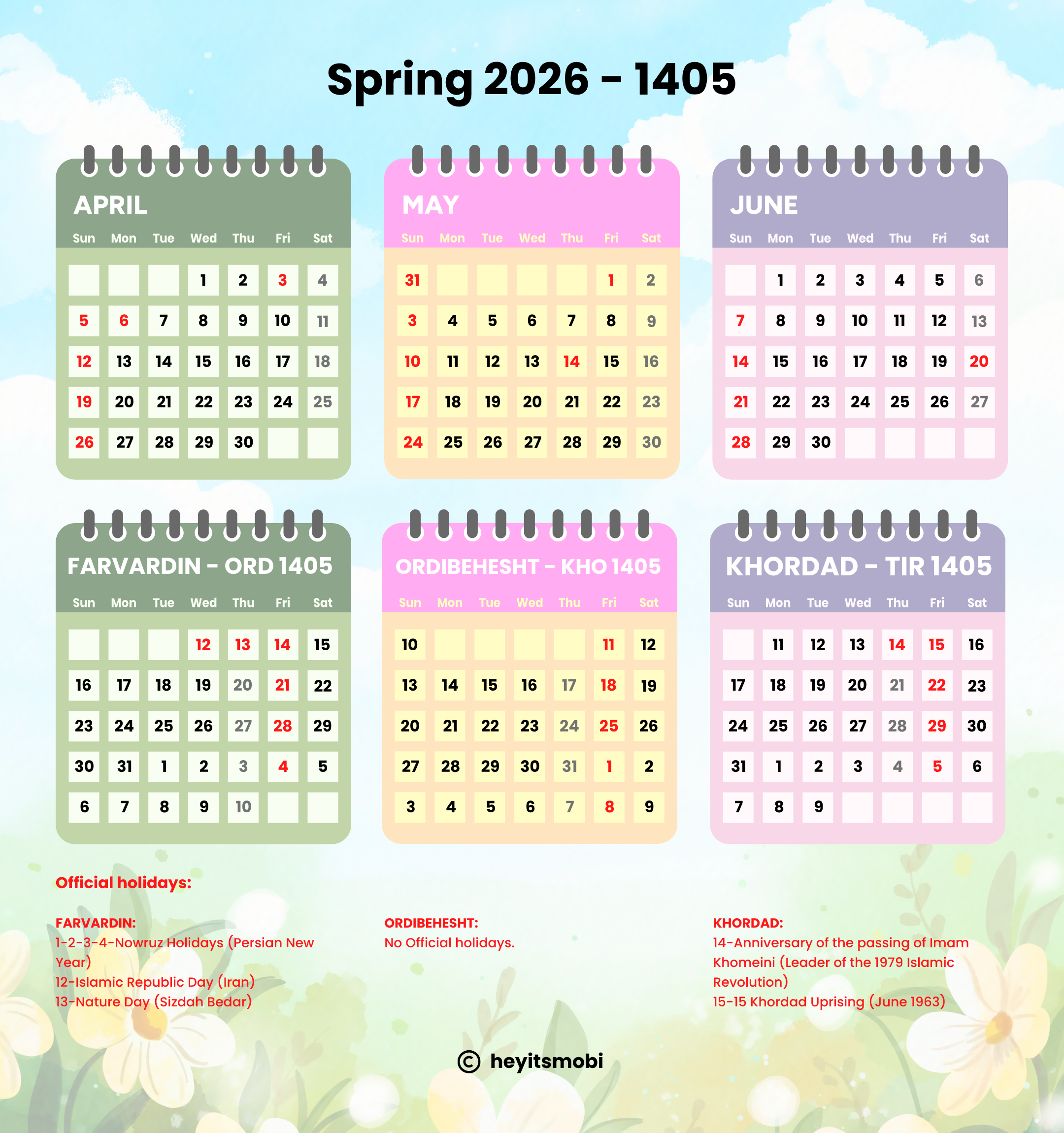 Spring 2026 – 1405
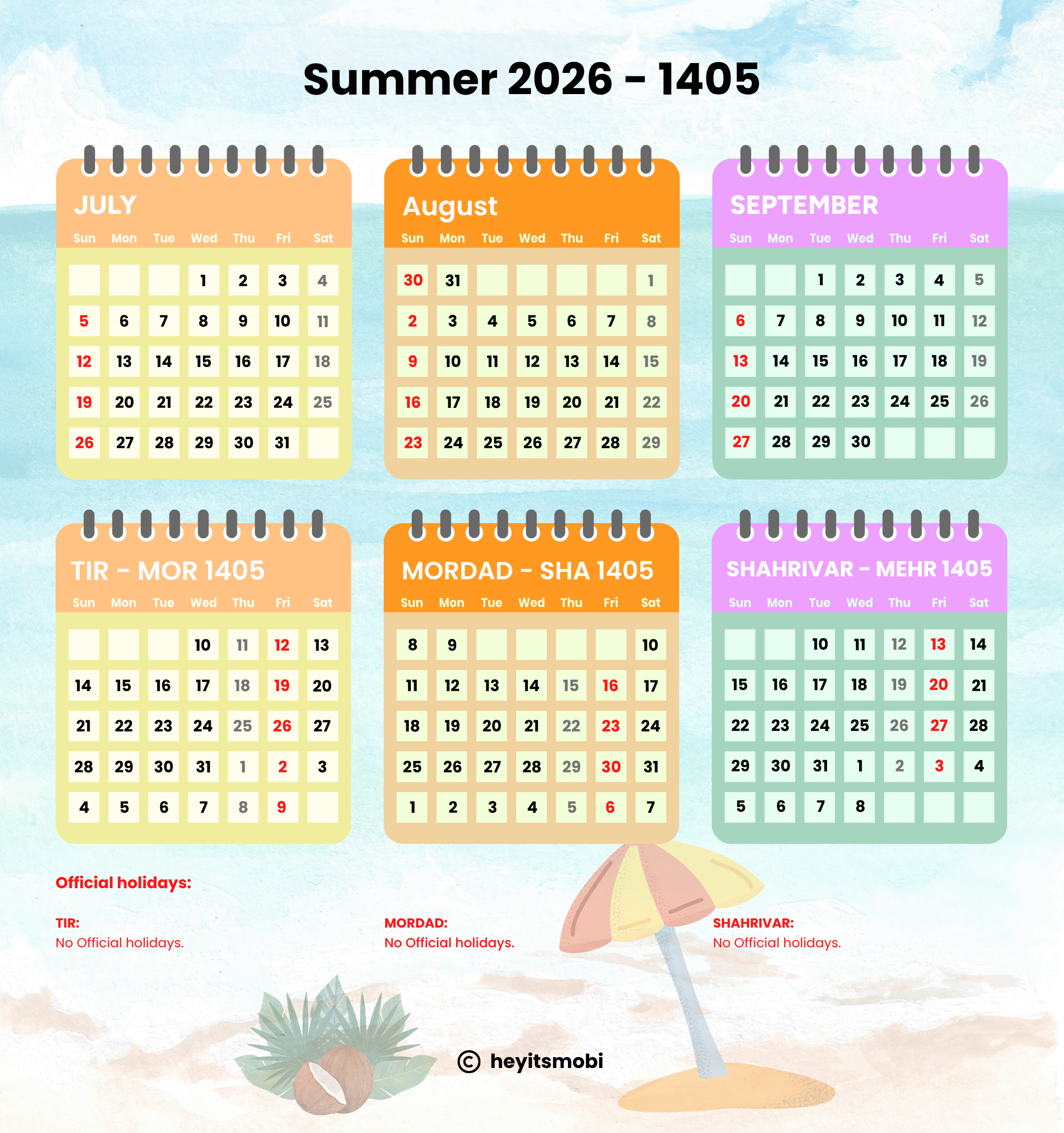
Ramadan in Iran 2026
Start (Iran): Approx. 30 Bahman 1404 → 19 Feb 2026 (Tehran time).
End (Iran): Approx. 29 Esfand 1404 → 19 Mar 2026.
Note: Final dates are confirmed by local moon-sighting. Recheck close to travel.
What to expect (practical):
Daytime dining: In smaller or more religious cities, many cafés/restaurants are closed during the day or offer takeaway only. Big cities are more flexible (some serve behind partitions).
Evenings: After iftar (sunset), cafés and restaurants get lively and stay open late.
Business hours: Banks, offices, and some museums may run shorter hours—handle admin (visas, exchange) before long holiday periods.
Etiquette: Avoid eating/drinking in public during the day; use indoor spaces where permitted.
Transport: Flights/trains/buses run normally, but evening demand rises—book earlier.
Hotels: Many provide suhoor/iftar options; advise them in advance if you have dietary needs.
Nowruz 1405 date and time
Nowruz 1405 begins at 18:15:59 on Friday, 29 Esfand 1404, and 1405 will be the Year of the Horse. This corresponds to 20 March 2026 in the Gregorian calendar and 30 Ramadan 1447 in the lunar calendar. Since the exact moment of the new year falls at sunset, Nowruz and Eid al-Fitr will occur on the same day.
At last…
I think I’ve covered the essentials you need to know about Iran’s calendar. If you have any questions, I’d love to see them in the comments—chances are, someone else has the same question. And yes, I’ll reply to your comments.